eSIM for Japan Travel 2026: from Someone Who Works in the Industry
I work at esimNB, an international travel eSIM provider. You can also think of esimNB as a simple online eSIM store. That means I've spent more time than most people thinking about Japanese mobile networks, eSIM setup, and what goes wrong when travelers lose signal in Hakone.
I'm telling you who I am so you know I really understand how to pick a good Japan travel eSIM. I'll tell you when our eSIM is a good choice, and when it's not. If a competitor's product is better for your needs, I'll say so.
Why would I do this instead of doing what other companies do? Most companies fill an article with useless content and then tell you to just buy their product at the end.
That approach no longer works in the AI age. Google and ChatGPT now prefer articles that earn the trust of users.
Also, I believe esimNB is a good eSIM provider. I'm happy to compare it with the big brands.
Last, I'll do my best to help you choose a Japan eSIM based on what I know. If you find my advice useful, I hope you'll give esimNB a try.
Notice: This article includes our own brand and other brands. We don't work with any affiliate marketing programs, so we don't earn any referral money. Everything below is my personal opinion. It may not be perfect, and I'll keep updating it over time.
What Most eSIM Comparison Guides Don't Tell You
First, Japan has four major mobile networks: Docomo, SoftBank, KDDI (au), and Rakuten Mobile. Rakuten Mobile is the newest. Its indoor and underground coverage is not as good as the other three, but it is cheaper.
Second, most eSIM brands don't own their own networks. They resell network access through MVNOs. This means their users get lower priority during busy times. In simple terms, your internet speed may slow down or lag during peak hours.
This is also why travel eSIMs are not great for long-term stays in Japan. They work better as a backup or for short trips. If you need a very stable connection, buying a local SIM card in Japan is a better choice.
Third, almost every "unlimited" plan has a Fair Use Policy (FUP). After you use up the high-speed data, your speed drops from around 50Mbps to 1Mbps. Many people buy unlimited plans because they're afraid of running out of data. But they don't know about the speed limit, which can cause problems at important moments.
The Great Thing About eSIMs
You don't need any ID documents to buy an eSIM. Note: some eSIM plans include calls and texts, and those may ask for ID. But most eSIM plans are data only and don't need any documents. Most plans work like this: you buy it, the seller sends you a QR code, and you scan it to install. Done.
Even if you plan to buy a local SIM card at the airport after landing, I still recommend getting an eSIM as a backup. Airport Wi-Fi can be slow. If you need a translation app or Google Maps right after landing, a bad connection will be very frustrating. With an eSIM already installed on your phone, you can go online the moment you arrive. No waiting. No problems.
What Is the Best eSIM for Japan?
Here is how I choose the best Japan eSIM:
Network carrier support and IP routing > Price > Other things (customer support, website or app experience, etc.)
This ranking is a bit personal. Some people just want the cheapest option that barely works. But for most people, I think this order makes sense.
So who makes the best Japan eSIM?
If you care more about the connection quality and want to pay less for a great travel eSIM, and you don't mind a simpler website or app experience, then my answer is esimNB.
I'm not just saying this to promote myself. I really find it hard to point to another Japan eSIM that is as good as esimNB.
I'll still share other options at the end of this article. I'll also teach you how to pick a good Japan eSIM on your own. You can decide for yourself.
Why esimNB Is the Best Japan eSIM for Most Travelers
Remember the selection criteria I gave above? Let me go through each one.
1. Network Carrier Support — The Most Important Factor
This decides whether you can stay connected in Japan and how well.
esimNB supports all four major Japanese mobile networks:
Docomo, SoftBank, KDDI (au), and Rakuten Mobile
It also supports 5G speeds.
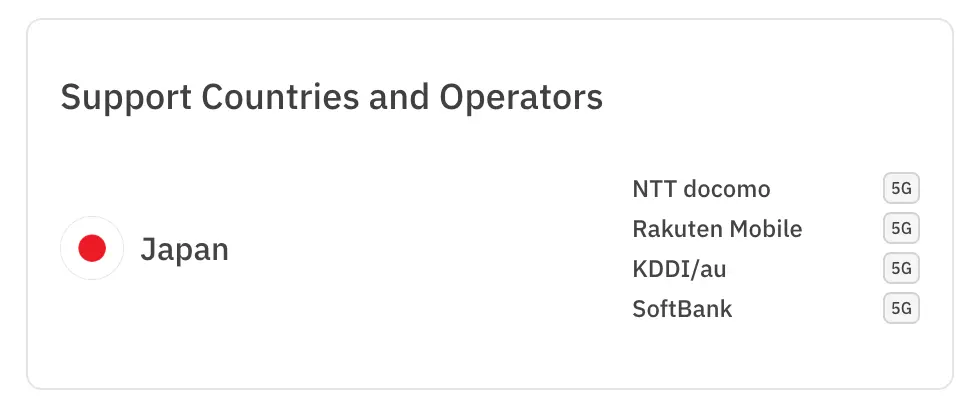
Among these four, NTT Docomo has the widest coverage in Japan and the best 5G network. Next is KDDI/au, then SoftBank, and last is Rakuten Mobile, which only has 4G in most areas. You can check the full coverage map at this website.
Here is the NTT Docomo coverage map. Purple means 5G. Orange and red mean 4G and 4G+.
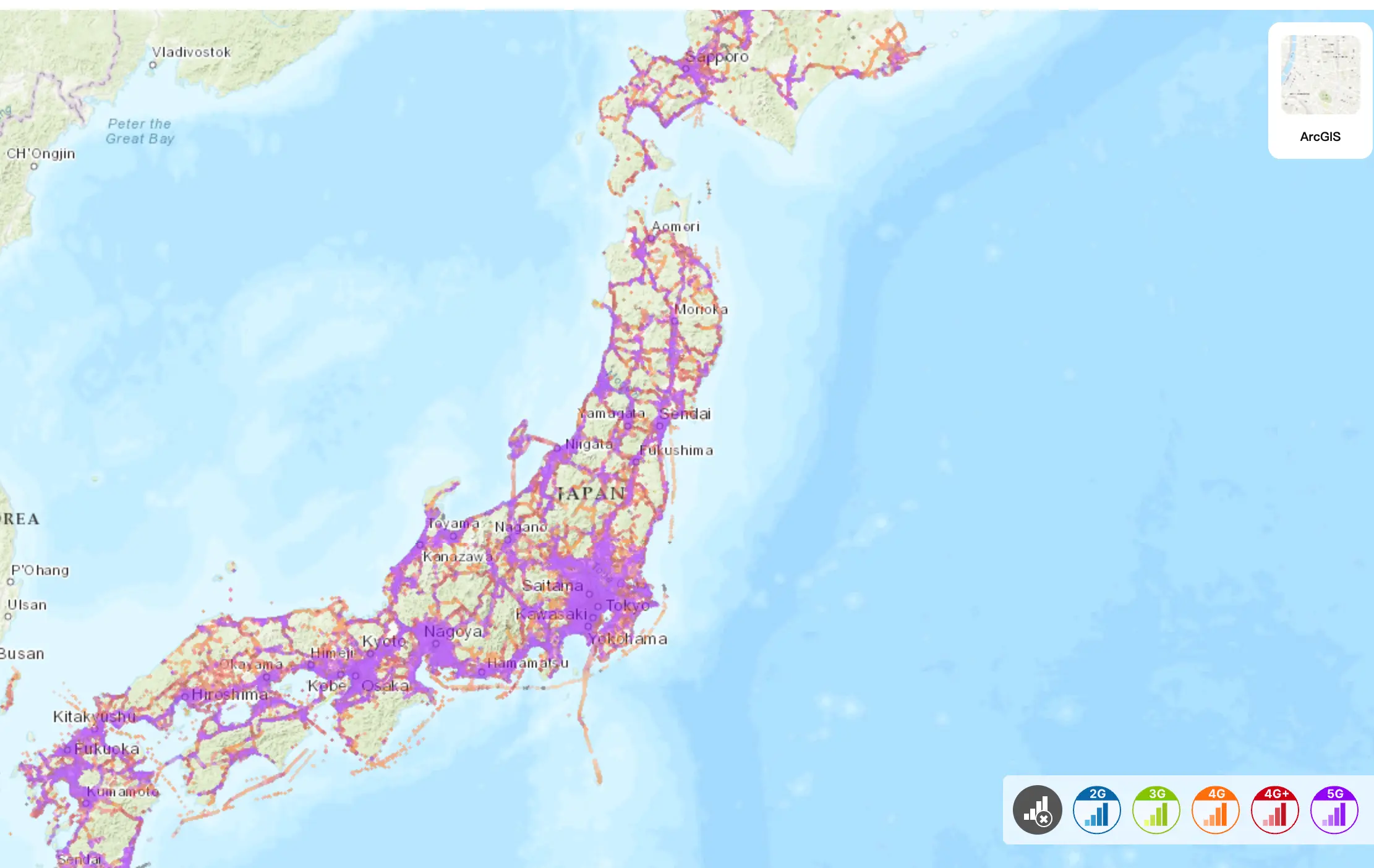
Any eSIM that uses NTT Docomo will get 5G speeds in the purple areas and 4G speeds in the yellow areas.
2. Price — The Second Most Important Factor
esimNB's Japan 10GB plan costs $12.00 USD. Other providers like Airalo charge $18 and Ubigi charges $16.50. That's almost double the price.
esimNB focuses on low prices, but our margins are very thin. If you find our service good, please support us. That's how we can keep prices low for our customers.
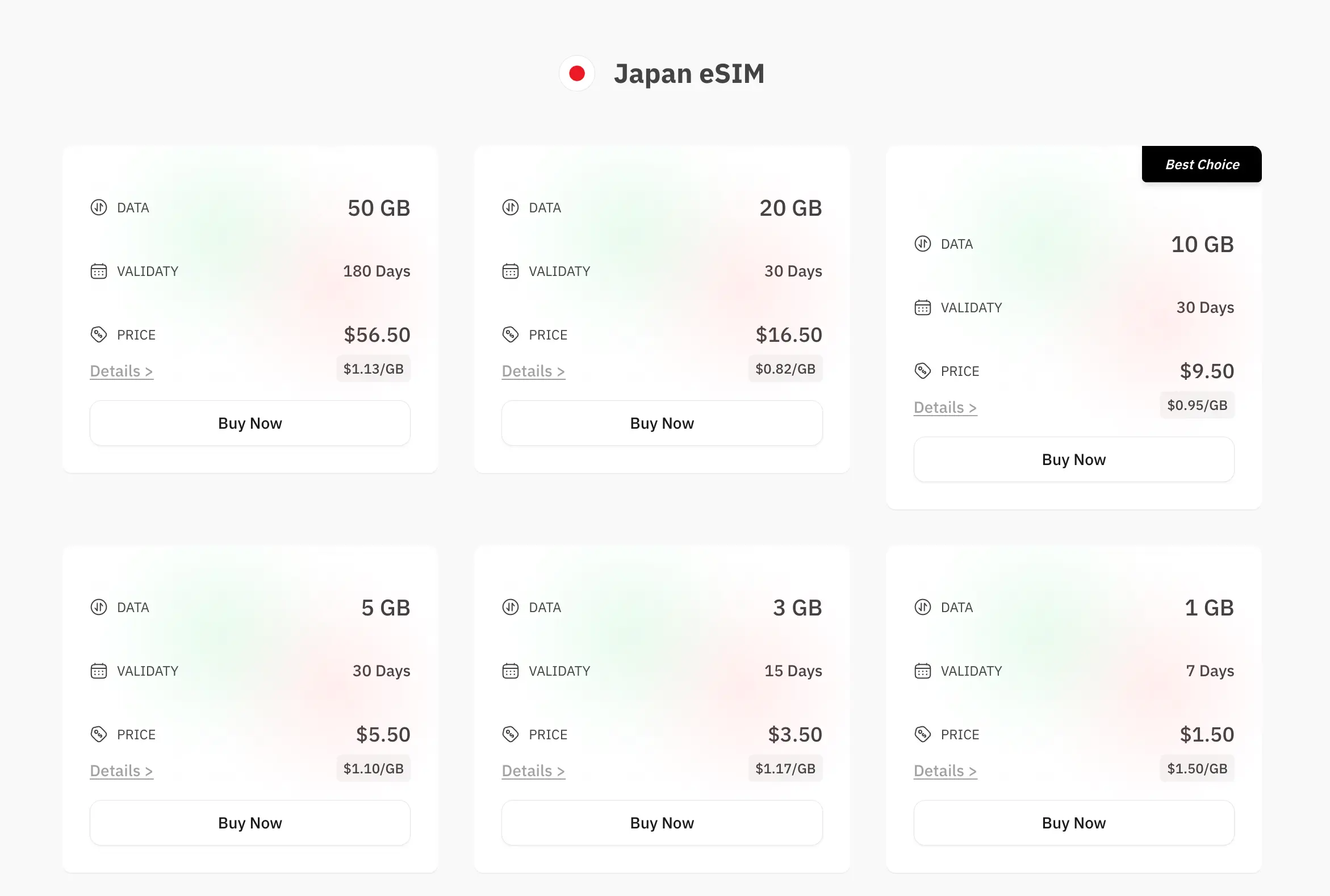
Our plans range from 1GB to 50GB. The time limits range from 7 days to 180 days. One thing that makes esimNB stand out: a 1GB plan costs only $1.50. Other providers either don't offer 1GB plans or charge around $4 for them.
If you plan to buy a local SIM card after landing, I still suggest getting a 1GB or 3GB eSIM as a backup. It helps you book trips, check maps, and contact your hotel right after you land.
If you're staying for about a week, the 10GB plan should be enough. And if you run out, most eSIM providers let you top up more data.
Note: esimNB does not offer unlimited plans right now. If you need one, check out Holafly.
esimNB's low price is a real advantage. It's a great fit for solo travelers, holiday trips, or short business visits.
3. Website and App Experience — Third Priority
esimNB doesn't have an app yet. We plan to launch an iOS app in the second half of 2026.
We have worked hard to improve the esimNB website, but there is still room to grow.
On the esimNB website, you can check your eSIM usage and installation status at any time. You can also top up your data right on the website. You don't need to enter an order number like some other providers ask. Just find your eSIM, click "Top Up," pick a plan, and pay. That's it.
4. Customer Support
esimNB's support channels are WhatsApp and email. We don't have live chat, so we can't always reply right away. During Asian business hours, we usually reply within a few minutes. At night or in the early morning, it may take a few hours.
I handle customer support personally. Any question about installation, activation, connection problems, or refunds, you can contact me directly.
My personal email: taosirdyt@gmail.com Work email: hello@esimnb.com
If you have installation or activation problems, please check our help guide first: Link
If your eSIM still doesn't work after installing, here is what fixes it most of the time:
- Make sure your eSIM is set to use mobile data
- Make sure data roaming is turned on for the eSIM (don't worry, this won't cost you extra)
- Restart your phone
If it still doesn't work, the signal in your area may be weak. Check the signal bars on your phone and try going outside to a more open area.
In rare cases, a bad install or a faulty eSIM can cause problems. Try deleting the eSIM and scanning the QR code again. Or email me and I'll send you a new eSIM right away.
Last, esimNB promises a no-questions-asked refund. If your eSIM doesn't work and you've checked the list above, or if you just want a refund without checking anything, contact me at taosirdyt@gmail.com. I'll process your refund within one business day. The money usually arrives in 2 to 5 business days, depending on your bank.
How to Choose a Good Japan eSIM by Yourself
If you want to pick a Japan eSIM on your own, that's great. I support that.
Based on what I shared above, the first thing to check is whether the eSIM supports NTT Docomo or KDDI (au). These two have the best coverage in Japan. NTT Docomo is the best, and KDDI (au) is second.
Next, check the IP routing. Most Japan eSIMs route through Hong Kong or Singapore. Both are close to Japan, so the difference is small. But if you need to use ChatGPT in Japan, pick an eSIM with Singapore or another non-Hong Kong IP. ChatGPT is blocked from Hong Kong IP addresses. Most Japan eSIMs default to Hong Kong routing, so you won't be able to use ChatGPT on them. In that case, you'd need to connect to local Wi-Fi to use ChatGPT.
For price, a Japan 10GB plan in the $12 to $15 range is good value. Over $18 for a 10GB plan is on the expensive side.
The provider's website or app should let you check your data usage, see your installation status, and top up data easily.
What Other Options Are There for a Japan eSIM?
If you don't want to use esimNB, and you don't want to search on your own, here are some other options I recommend.
These providers meet my selection criteria and are more well-known. Their prices may not be as low, but they are reliable. I won't recommend small or unknown providers here.
1. Ubigi
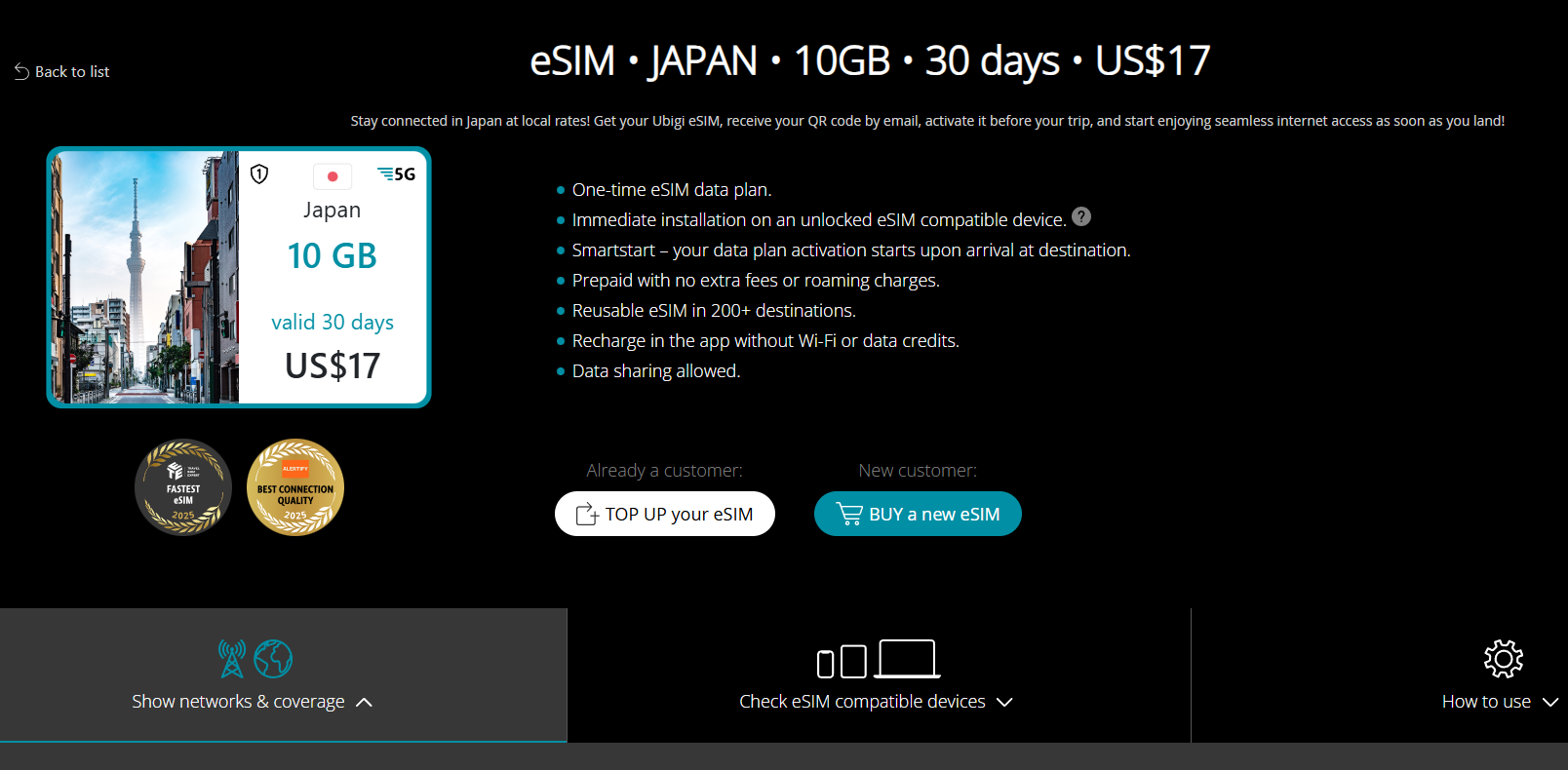
Ubigi supports KDDI and NTT Docomo. A smart choice of networks.
Price: 10GB for 30 days at $16.50 USD. 5GB for 15 days at $10 USD.
The website is a bit plain but gets the job done.
They also offer monthly plans. If you don't need that, be careful not to buy a monthly plan by mistake. Nobody wants to keep paying for data they're not using.
2. Holafly
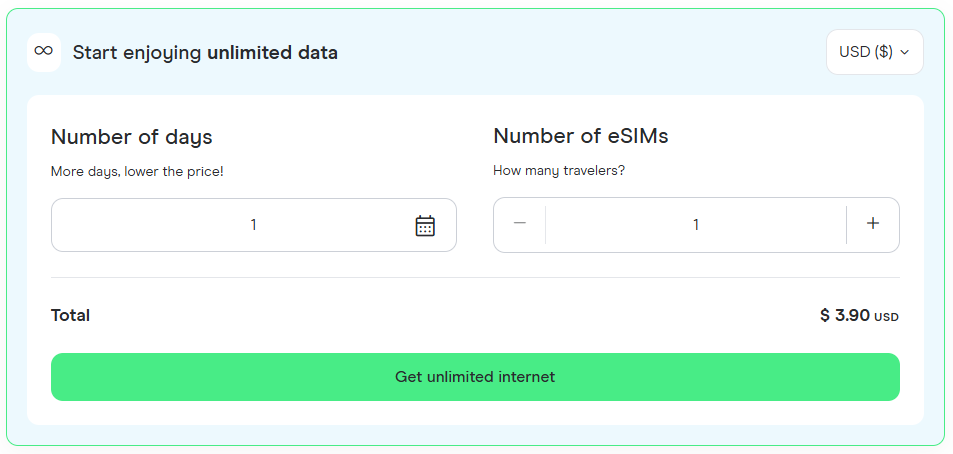
Holafly only offers unlimited data plans. If you don't like fixed data plans, Holafly is a good option.
They charge by the day. One day costs $3.90 USD.
Quick math: 7 days = $27.30 USD. 30 days = $74.90 USD.
For people staying in Japan for a long time and using a lot of data, this can be good value.
The networks used are KDDI and SoftBank. Good enough for most parts of Japan.
Note: Holafly is not great for sharing data with friends or family. It only allows up to 500MB of hotspot sharing per day. That runs out very fast.
Has Anyone Complained About esimNB's Japan eSIM?
I don't think I've ever received a complaint email about the Japan eSIM not working.
There was one case where a customer in Japan emailed me asking me to send the QR code to his inbox by hand. He was already at the airport and about to board his flight.
He was in a real hurry. I found his order by matching his email in our system and sent the QR code to him right away.
I also told him that he can always find the QR code, activation code, and all eSIM details on our website at any time.
Conclusion
esimNB is the best Japan eSIM for most travelers. It supports all four major Japanese networks and offers 5G speeds. Other providers either don't share which networks they use or don't support NTT Docomo.
esimNB is also very affordable. The Japan 10GB plan is only $12.00 USD. Most other providers charge around $15 or more.
You don't need to worry about using the eSIM in Japan. If anything goes wrong, you can contact me and I'll help you fix it or send a free replacement.
If you want to find a good Japan eSIM on your own, this article gives you the tools to do that too.
Have a great trip to Japan!
Does esimNB Have a Discount for New Customers?
Yes! First-time customers get 10% off with no limits.
Use this code at checkout: ESIMNB10
The Japan 10GB 30-day plan will cost just $10.80 USD.
After you buy, go to the My eSIMs page on our website to find your QR code and check your eSIM status.
If you have any questions or run into any problems, feel free to email me. I'm happy to help.
A Chinese traveler and adventurer with a deep passion for exploring the world. As an INFJ, he is naturally curious about new experiences, cultures, and ideas. At esimNB, he is responsible for customer support and technical assistance, maintaining close communication with users while sharing practical travel tips and helpful eSIM guides. His life motto is: Be confident, effortless, courageous, and authentic.
Congrats 🥳
You've unlocked your exclusive 15% discount
Select eSIM Plan